Scania Interaction Design & Automotive HMI

Lead designer of the startup and shutdown interaction behaviour of Scania's new vehicle generation

Parts of this project are under NDA. If you'd like to learn more, please reach out. sanna.s.klefbom@afry.com

I was the lead UX designer of the startup and shutdown interaction behaviour of Scania's new vehicle generation, Smart Dash. I designed the interaction architecture of triggers, screen feedback and system timers in tight collaboration with system architects, function owners, the requirement team and the safety team. The work introduced a new user experience for all new Scania vehicles when starting and ending a drive.

Role Lead UX Designer
Time 1 year · 2023–2024
Team System architects, function owners, requirement writers, motion designer, UI designer, UX designer
From the team

“You are a very committed, competent and genuinely interested designer! Your contribution in building Scania Smart Dash was hugely appreciated and you can be sure that you have left your mark on what you have worked on! I would not hesitate, not even for a minute, to have you on a team in the future.”

Juliana Moreira, Product Owner, Scania
Read more about the project

Problem statements

The startup and shutdown had to be rebuilt around new technology and new driver expectations.

User problem

Drivers needed the vehicle to be quick and responsive, surfacing the right information at the right time. The experience had to feel aligned with modern, connected vehicles while staying grounded in the legacy of the previous generation they already knew.

Business problem

Scania was in the beginning of creating a completely new vehicle generation, moving from local, offline vehicle systems to connected, intelligent systems with large screens replacing many of the physical buttons. The new systems were smarter and more powerful, and behaved differently at startup and shutdown than the previous generation. Scania needed to define a new user experience when starting and ending a drive, founded in the technical behaviour of the new vehicle systems, that also met the evolving expectations users bring to connected vehicles.

Impact

100k +

Driving users across all Scania vehicles

The work introduced a new standard interaction architecture for every Scania vehicle when starting and ending a drive.

100%

Of the Smart Dash HMI teams adopted the design outcome

The work set the system-architectural foundation and vehicle-state behaviour of the whole platform, impacting every HMI team working with Smart Dash.

5 +

New work epics crucial to the release

The investigation behind this work surfaced more than five completely new work epics crucial for release, engaging multiple teams.

Approach and rationale

Every design decision aimed to keep drivers' eyes on the road and hands on the wheel.

Drivers of Scania's trucks often work in high-risk, pressured and time-critical situations with essential societal functions, such as fire trucks, waste management, construction-site vehicles, timber and logistics. Their primary need is design and technology that feels safe, stable, clear, trustworthy and accessible. As a designer it was therefore important to work closely with drivers, but also closely with the people who develop, specify and build the systems, so that the design is always technically feasible in a safe and stable way.

Research

We wanted to know both sides of the story, the human and the machine.

Through user interviews and fieldwork, we built an understanding of how drivers behave and what they need when approaching and leaving the vehicle. Understanding the technical context of the new vehicle systems mattered just as much, since the design possibilities depended directly on it.

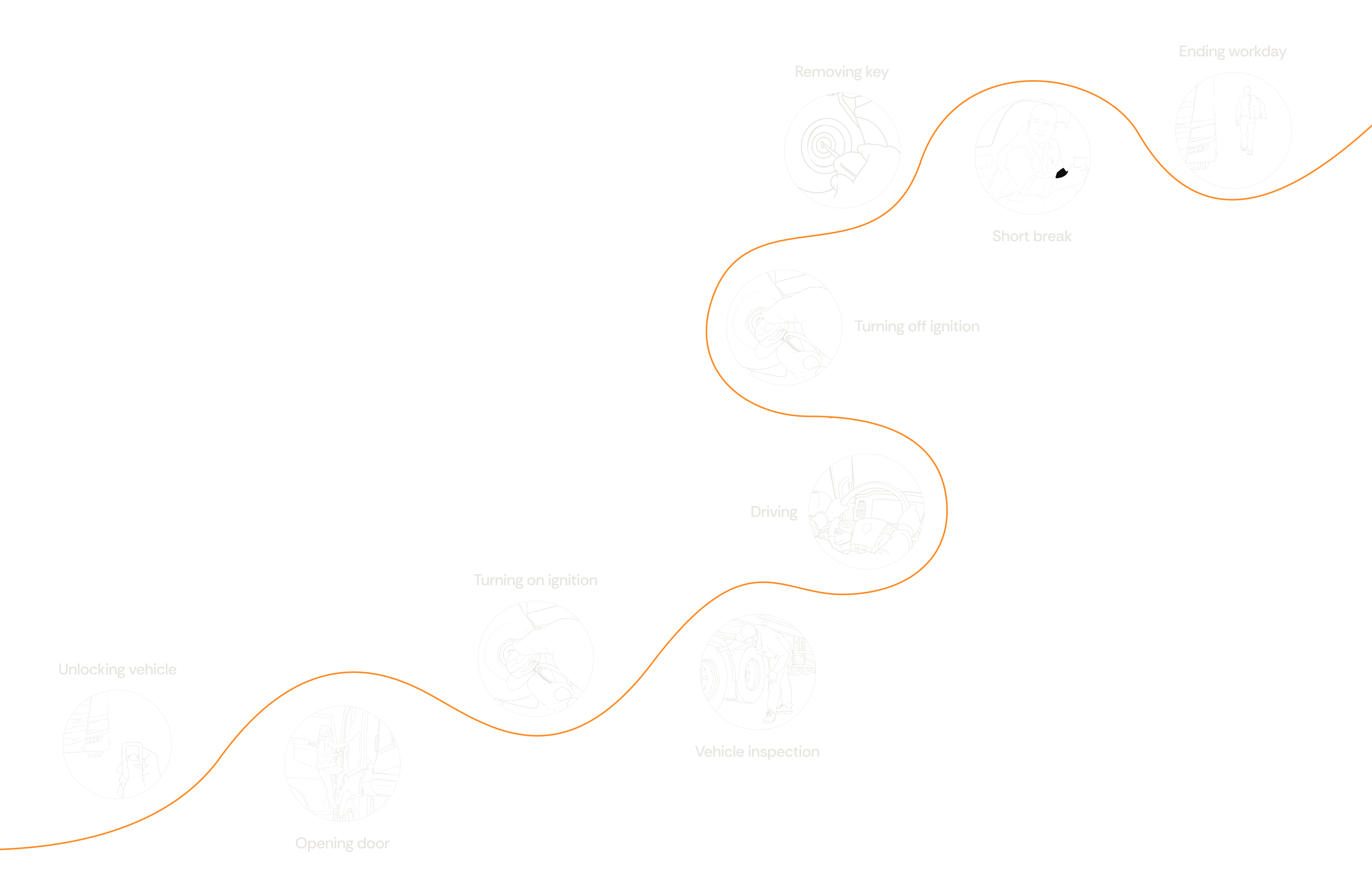
Hand-drawn user journey sketch of the startup and shutdown experience, from approaching and entering the vehicle through to ending the drive and leaving it, drawn as a continuous line rising from the bottom-left to the top-right.

Discoveries

The opportunity was to rethink how triggers, screens and timers worked together.

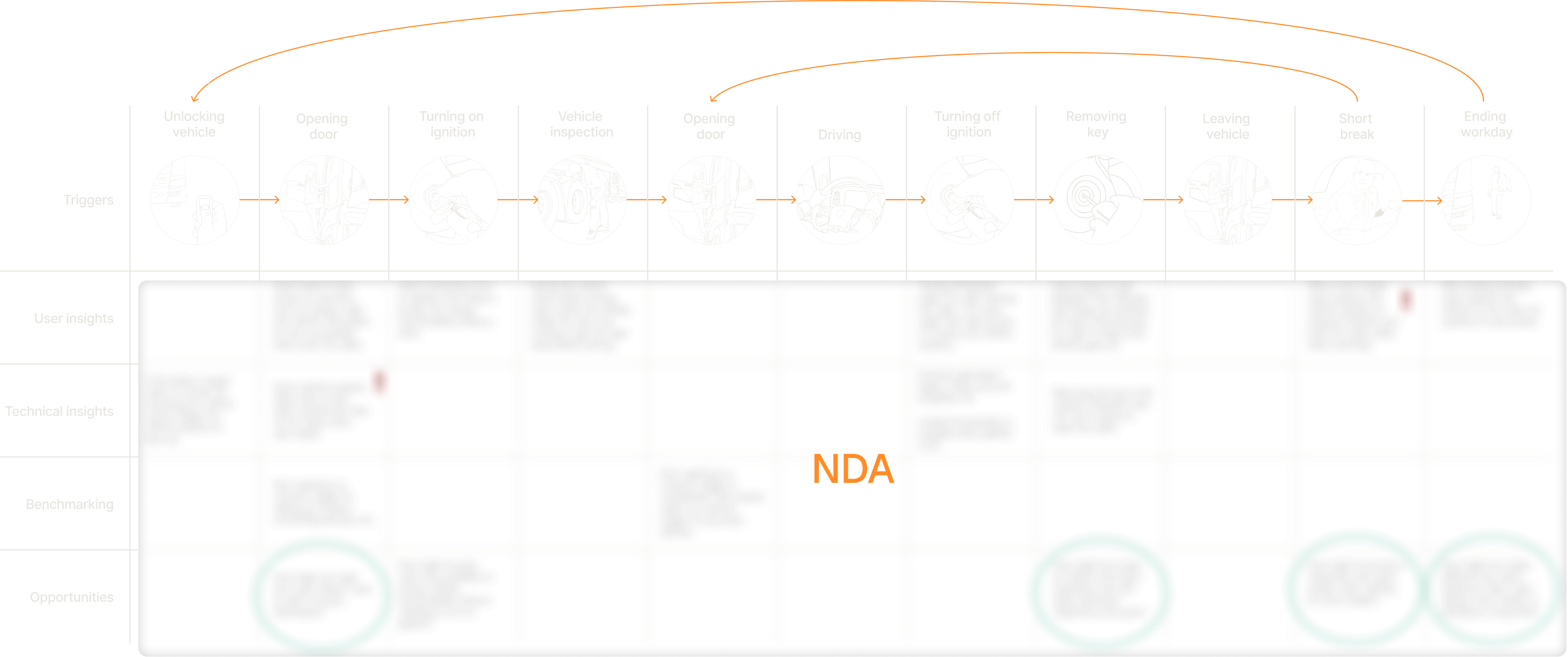
I mapped all the research data into user journey maps and found design opportunities across user insights, technical insights and benchmarking. We saw an opportunity in rethinking the interaction architecture of the various systems, screens and timers, to create a more efficient, robust and premium startup and shutdown experience.

Exploration

The more trigger flows we sketched, the wider the scope of systems became.

Together with the system architecture team I started sketching trigger interaction flows that would address the findings from the research. The video below shows a lo-fi prototype similar to what we used as discussion material in design reviews and in workshops with system architects, requirement writers, function owners and developers. It focused on user triggers and screen feedback. Each iteration surfaced new work areas, and we learned that we had to widen the scope of functions and systems included in the journey.

Testing

We tested in simulated driving environments and in real trucks, before and after release.

Behavioural observations

Early prototypes tested with drivers in a simulated driving environment.

I created Figma prototypes that were tested by drivers in a simulated driving environment. In the early exploration stages we set a scenario for the drivers and observed their behaviour, learning their pain points across various startup and shutdown interaction flows.
Iteration

Pain points from observed behaviour set the focus for the next round of testing.

A/B tests

Specific interactions compared head to head after each iteration.

After new iterations we ran A/B tests with drivers in the same kind of simulated driving environment, this time focused on specific interactions in the journey. The tests were followed by iterations and ran throughout the whole design process, in both simulated and real truck environments.

Iteration

Validated interactions carried into the real truck environment and, eventually, release.

Fieldwork after release

Visiting a large customer to hear from every kind of Smart Dash user.

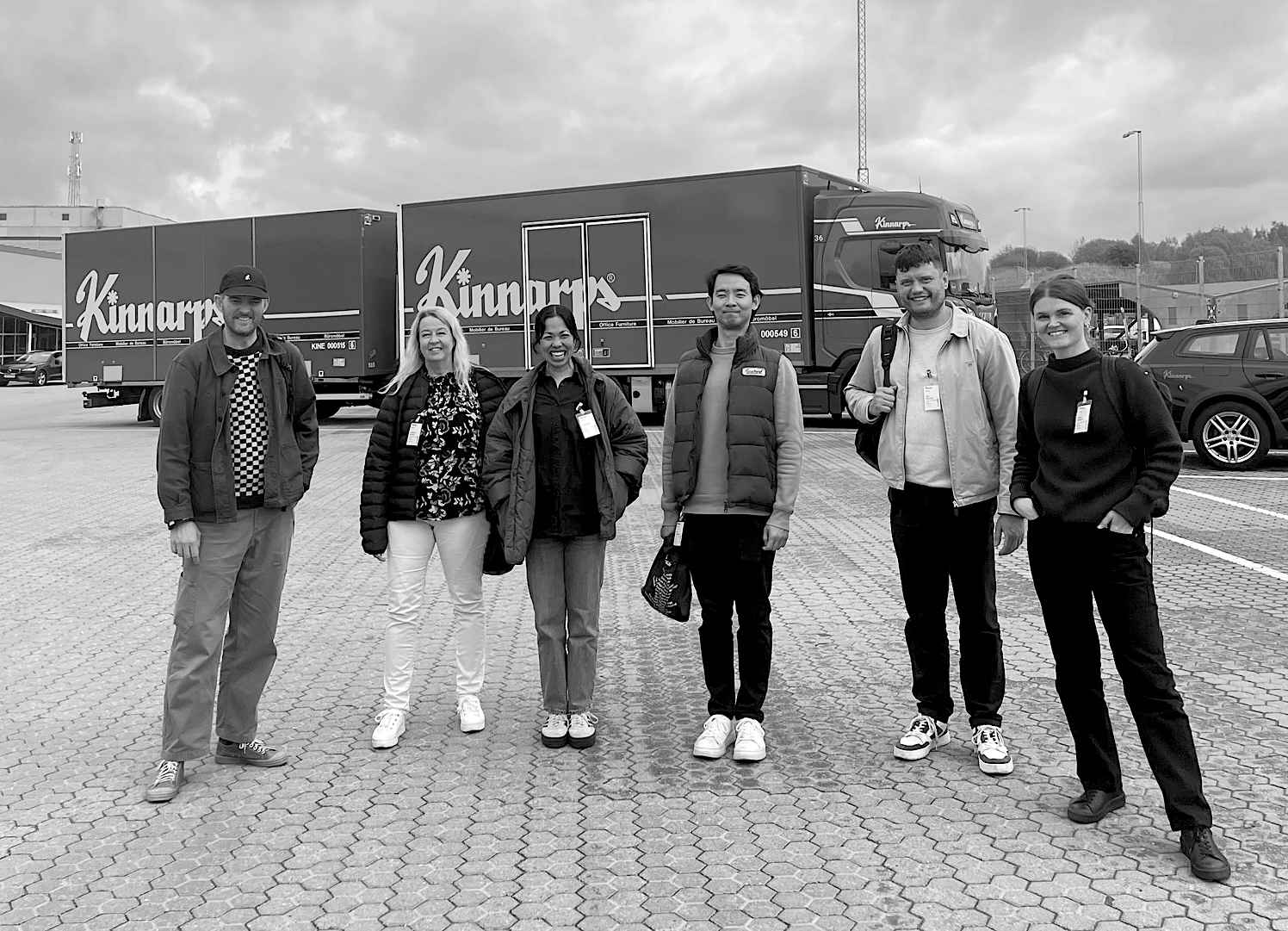
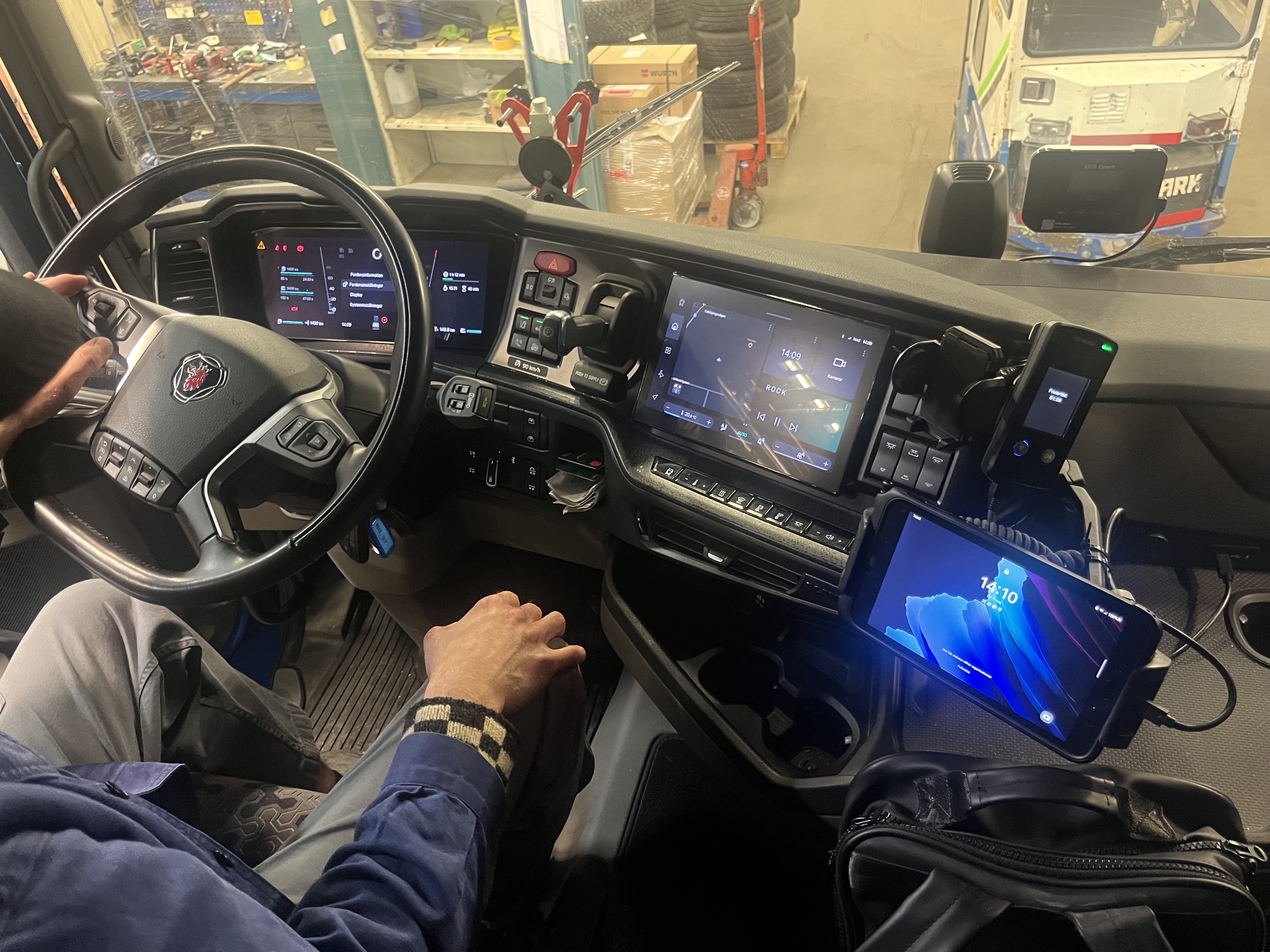
After the release of Smart Dash we visited a large customer, Kinnarps, to talk to drivers about their experience with the new systems and instrument panel in real truck environments. The users of the Smart Dash ecosystem are not only drivers but other expert users, such as dealers, warehouse workers and mechanics interacting with the vehicles daily. The visit gave us valuable insights from every user group to carry into further iterations and bug-fix prioritisation.

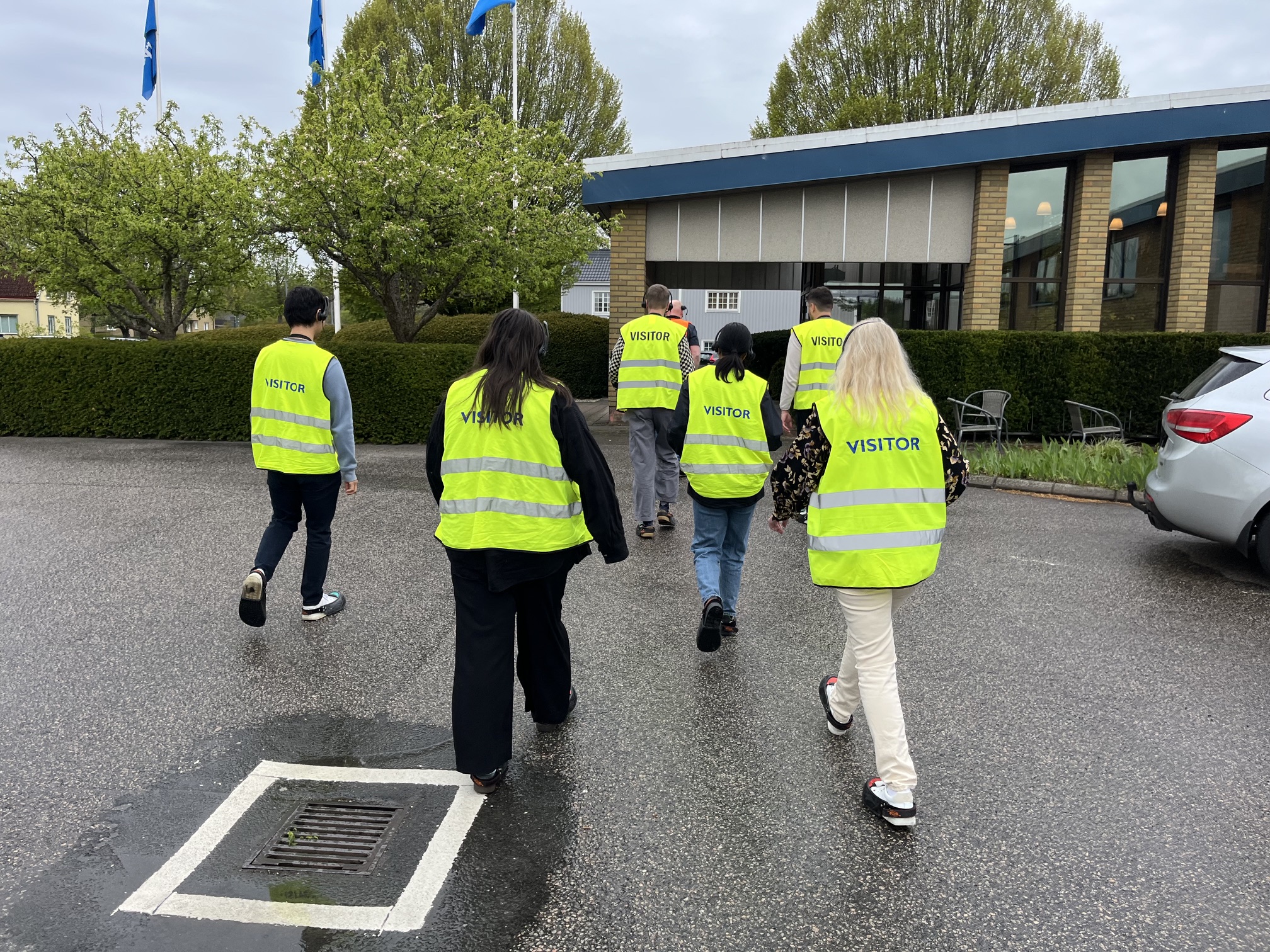
Fieldwork at Kinnarps after the Smart Dash release — the design team visiting the customer site to meet drivers and other expert users of the new systems.
Fieldwork at Kinnarps after the Smart Dash release — talking with a driver in a real truck cab about the new startup and shutdown experience.
Fieldwork at Kinnarps after the Smart Dash release — the new instrument panel and systems observed in a real truck environment.
Result

Insights from real-world use fed directly into iteration and prioritisation after launch.

Delivery

A complete interaction architecture for starting and ending a drive.

The delivery was the interaction architecture of triggers, timers, screen, light and audio feedback for starting and ending a drive across all new Scania vehicles.

The full delivery

Technical flows Technical interaction flows explaining system behaviour, screen feedback, audio, light and timer behaviour for each user interaction in the startup and shutdown journey.
Storyboard & maps Storyboard and user journey maps explaining each step of the startup and shutdown user journey.
Boot-up animation UX strategy for the boot-up animations and screen transitions.
Limited View UX design of Limited View: information architecture, interaction flows and wireframes.
Screen states UX design of the screen-state behaviour of the Driver Display and Center Information Display (interaction flows).
Vehicle states UX strategy for vehicle states.
Light & illumination UX design of light and illumination behaviour (interaction flows).
Error states UX design of error states: interaction flows, wireframes and UI.

Outcomes

A new standard for starting and ending a drive, now live across Scania's new vehicle generation.

Shipped

A complete interaction architecture of triggers, timers, screen, light and audio feedback for starting and ending a drive across all new Scania vehicles, used daily by drivers all over the world.

Significance

Utilised the possibilities of new smarter, connected digital systems to trigger the right information at the right time, giving users an efficient and responsive startup and shutdown experience.

Reflected

I learned how to lead the UX design direction of a highly complex technical system, where multiple stakeholders and interests all had to be understood to reach a qualitative outcome.

It pushed me to develop strong storytelling skills, using Figma prototypes as communication material and adjusting the message for the right stakeholder audience, and it developed my system and service design thinking, keeping the business perspective present throughout.

" ". .